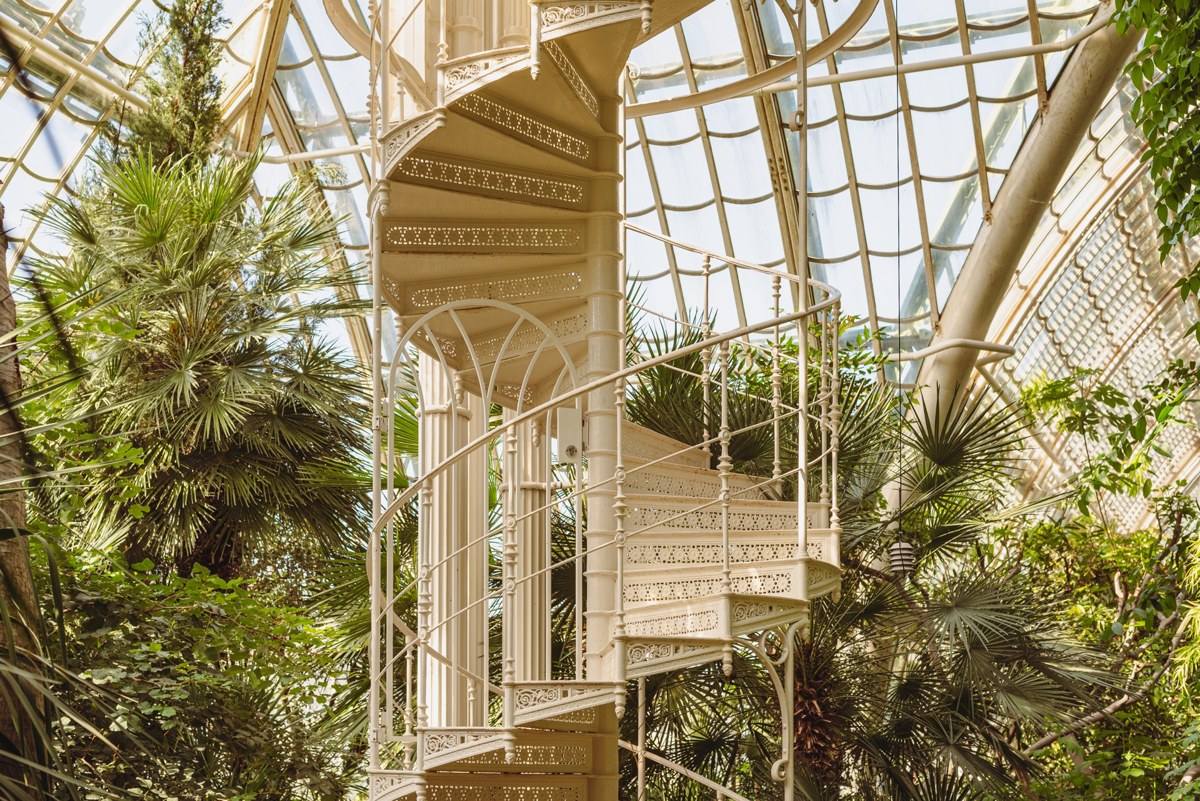
A quick check of where today's world models are, including ones you can host yourself. Every model got the same single photo. For each, see the video it can produce and the 3D world you can walk through, with what it cost to run. Ranked best first.
▶ Play video plays what the model generated from the photo, right here.
↗ Open 3D walkthrough opens the model's 3D world in a new tab: drag to look around, scroll to move.
Cost is the compute for one result, from Modal billing or each service's pricing.
Only NVIDIA Lyra generates a real video. The other world models output 3D directly, so they have no video.
Results, best first
Ranked by how convincing the result is, judged by eye on this one photo (9–10 Oct 2026). Lyra total across all runs: $7.29 on the Modal dashboard, from the free $30 monthly credit. Marble used the World Labs API's included credits. Everything else ran free.
More detail
The full NVIDIA Lyra story (inputs, intermediate outputs, distilled vs full quality, a refinement experiment) is on its own page. We also tested whether a coding agent (Claude Code writing Three.js) or a hybrid of code and a world model does better than world models alone:
photo viewstep back
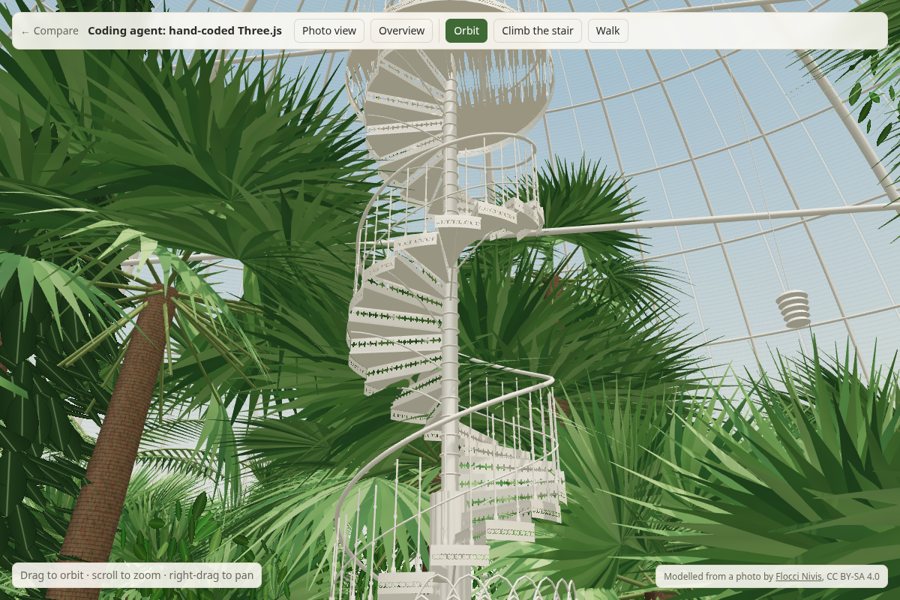
coding agentThree.js
Hand-coded scene
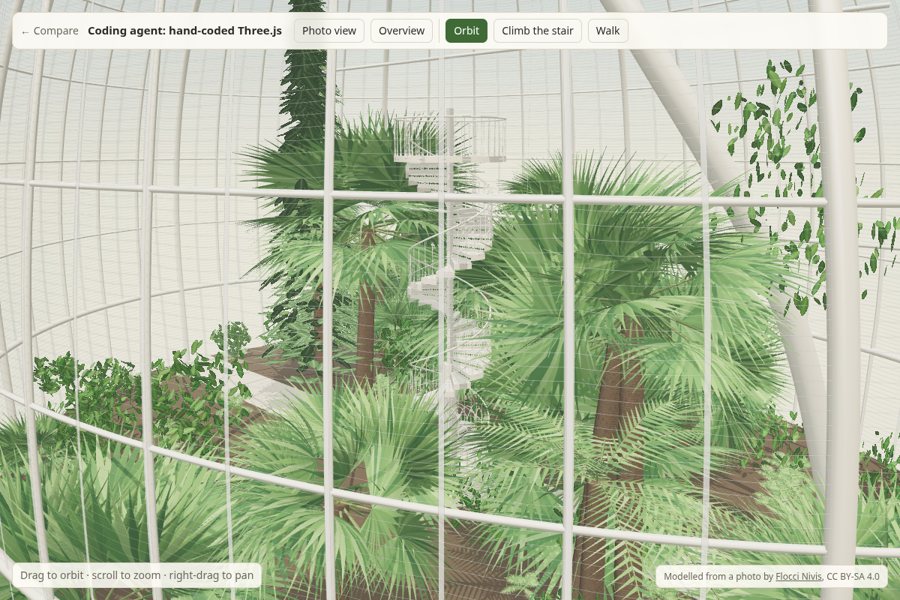
About 1,000 lines of procedural code: a parametric spiral stair, a ribbed glass dome and instanced palms. Works from every angle; you can walk the floor and climb to the top gallery. It looks stylised next to the photo.
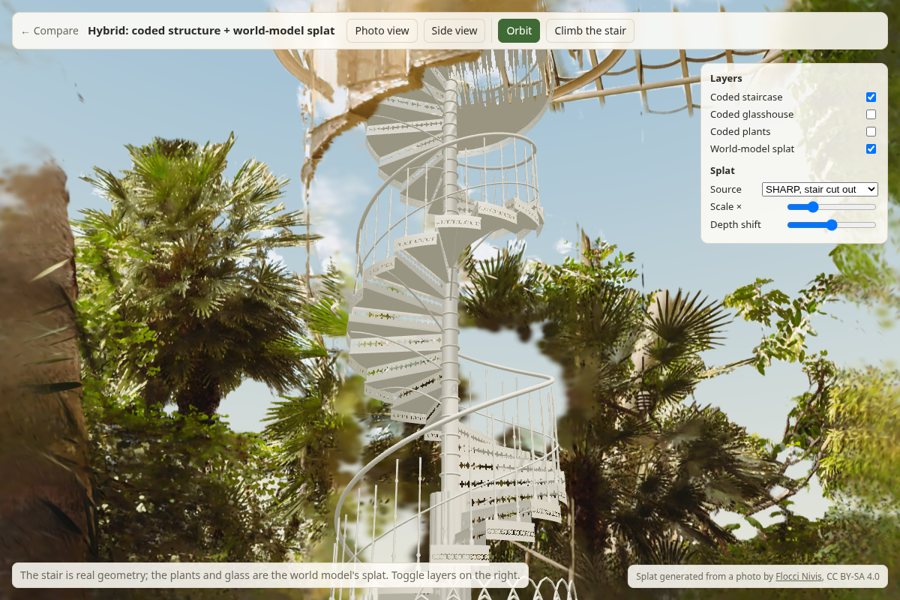
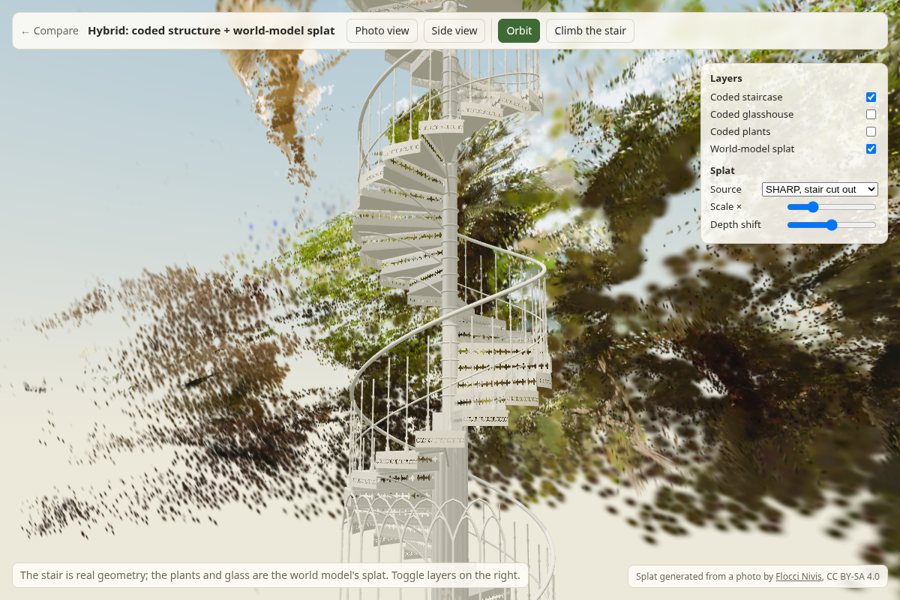
The world model's own stair is cut out and the coded one takes its place, aligned to the photographer's position. Photographic palms and light, plus a stair you can climb and edit.
Judged by eye in the viewers on 9 October 2026; no automated metrics yet.
What we checked
Coding agent
SHARP
HY-World 2.0
Lyra 2.0
Hybrid
Looks like the photo (from its viewpoint)
Recognisable, stylised
Near-photographic
Stair sharp, sky and glass missing
Photographic; filigree and roof kept
Photographic plants, stylised stair
Holds up when you move
Every angle
Breaks after 1–2 m
Breaks after 1–2 m
Holds along the generated path
Stair yes, plants break
Fine ironwork (filigree, balusters)
Approximated by textures
Smoothed away
Pierced pattern kept
Kept
Coded approximation
Behind the stair / outside the frame
Whole glasshouse built
Empty
Empty
Invented (orbit run)
Coded stair only
Walk and climb
Yes
No
No
No
Yes (stair)
Editable (steps, radius, layout)
Change a parameter
No
No
No
Stair only
Time to result
One agent session
~8 min (mostly GPU queue)
~14 min queue, 0.73 s inference
~11 min / ~44 min of one H100 (~$0.74 / ~$2.92), distilled / full
Both, plus alignment
Download size
52 KB of code
16 MB (500k splats)
8.3 MB (271k splats)
~60 MB (4M of 11.2M splats, .spz)
~15 MB
What this suggests
World models win the first look
From the photo's own viewpoint, both splats beat hand-written code on realism, especially the foliage, which is the hardest thing to code.
Generating a video first changes the picture
Single-shot models (SHARP, HY-World 2.0) only know what the camera saw. Lyra generates the unseen views as video first, so its 3D has a believable back side. Code still wins on walking, climbing and editing.
The hybrid is the useful one
Let code own the structure you interact with and the world model own the texture-heavy surroundings. The two needed only a scale fit to line up: SHARP's metric depth matched the coded stair within 8%.
World-model prompts to try
Prompts for hosted world models that generate whole explorable worlds rather than reconstructing one view. Upload the photo as the image input where the tool accepts one.
World Labs Marble (image + text, free plan: 4 worlds)
Interior of a 19th-century Victorian palm house conservatory in Vienna. At the centre, a white-painted cast-iron spiral staircase winds anticlockwise around a slender central column up to a circular gallery high under the roof. The stair has pierced filigree risers, scrolled side panels, beaded balusters and a curved handrail, with a gothic-arched iron gate at its base. Above, a tall curved glass roof on cream iron ribs, with scalloped overlapping glass panes and a large diagonal tubular iron beam. Dense tropical planting all around: Mediterranean fan palms, a tall dark conifer, ferns and broadleaf climbers. Bright, hazy daylight through the glass, soft shadows, a gravel path around the stair's base.
World 1: photo + this prompt. World 2: the same with Expand on, to see what it invents behind the stair. World 3: block out a cylinder (stair) and a dome (roof) in Chisel first.
Text only (Marble, HY-World online, any text-to-world model)
A walkable Victorian glasshouse. In the middle stands a three-storey white cast-iron spiral staircase with perforated lace-like risers and slender turned balusters, rising to a round viewing gallery just below a soaring curved glass roof. Fan palms, tree ferns and climbing vines fill the space; a gravel path circles the stair. Midday sun diffused through old glass, warm cream ironwork, deep greens, gentle haze. Camera starts at ground level a few metres from the stair, looking up.
Useful as a control: how much does the photo itself help compared with a description?
Interactive world models (Genie 3, LingBot World on Reactor, Odyssey)
First-person explorer inside a sunlit Victorian palm house. Ahead, a white cast-iron spiral staircase with filigree steps winds up to a gallery under the glass roof. Walk forward along the gravel path, circle the staircase once, then climb it to the top gallery and look out over the palm canopy.
Score it on whether the staircase keeps the same shape as you circle it, and whether you can actually climb it.
Reproduce
world-model/run_spaces.py sends the photo to the HY-World 2.0 and SHARP Hugging Face Spaces (a free HF token raises the GPU quota).
world-model/ply_to_splat.py converts each .ply to the compact .splat format used here.
world-model/cut_stair.py fits each splat's scale to the coded stair and cuts out the world model's own stair for the hybrid.
site/coded/js/ holds the coded scene: staircase.js, glasshouse.js, plants.js.